王生王生故事男主角,一个被美色迷惑的书生,不听妻子劝告,终为恶鬼所害。,太原人。早行,遇一女郎,抱襆襆包裹、行囊。古代出行常以布帛包裹衣物行李,称为"襆"。独奔,甚艰于步。王生趋问之,女惨然曰:「父母贪贿,鬻妾朱门。嫡妒甚,朝詈而夕楚辱之。」王悦其色,遂匿之斋中。
妻陈氏疑为大家媵媵古代贵族嫁女时的陪嫁女子,亦泛指妾室。此处陈氏怀疑女子是富贵人家的逃妾。,劝遣之。王不听。偶遇一道士,见王生,愕然曰:「君身有邪气邪气不正之气,此处指被鬼魅侵染后的晦暗气息。道士一眼看出王生被妖物缠身。萦绕,何也?」王亦疑之,既而思女子之美,遂以为道士借此求食,不之顾。
Wang王生 Wáng ShēngThe protagonist, a scholar from Taiyuan whose lust blinds him to danger. He ignores his wife's warnings and pays with his life., a man of Taiyuan, was walking early one morning when he encountered a young woman clutching a bundle襆 fúA wrapped parcel of belongings. In ancient China, travelers carried their clothes in cloth bundles called "fú.", running alone and stumbling with every step. Wang hurried to ask what was wrong. With a mournful face she said: "My parents, greedy for money, sold me into a rich man's household. His wife is furiously jealous — she curses me at dawn and beats me at dusk." Wang, captivated by her beauty, hid her in his study.
His wife Chen suspected the girl was a runaway concubine媵 yìngA woman who accompanied a noble bride as a secondary wife. Chen suspects the girl has fled a wealthy household. from a great family and urged him to send her away. Wang refused. One day he met a Daoist priest who, upon seeing Wang, exclaimed: "A malevolent aura邪气 xié qìAn unwholesome energy, here referring to the dark influence of a demonic entity clinging to Wang's body. clings to you — how can this be?" Wang felt a flicker of doubt, but then he thought of the girl's beauty and decided the priest was merely trying to beg for food. He paid him no mind.
王归斋中,女子已在。问所自来,曰:「愿从君子。」王喜,遂与寝处寝处同床共枕,此处指发生夫妻之实。文言文中"寝"常暗指男女之事。。居数日,密藏之,家人无知者。
一日,道士复遇之,曰:「君身邪气益重,何犹不悟?」王讷讷讷讷说话迟钝、支支吾吾。形容王生心中有疑但不愿承认的窘态。,心犹疑之。既而念:「道士言虽奇,然吾今何惧?」竟归斋中。
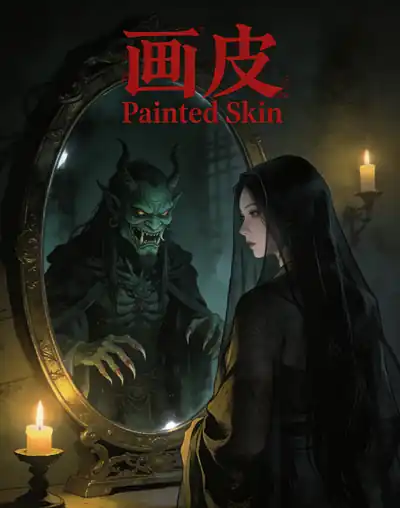
至斋门,门内闭。逾墙视之,见一狞鬼狞鬼面目狰狞的恶鬼。"狞"指凶恶可怖的样子。此处王生终于窥见女子的真面目。,面翠色,齿巉巉如锯。铺人皮于榻上,执彩笔画之。已而掷笔,举皮,如振衣状,披于身,遂化为女子。
Wang returned to his study to find the girl already there. When asked where she had come from, she said: "I wish to follow you, my lord." Delighted, Wang took her to bed寝处 qǐn chǔTo share a bed; in classical Chinese, "寝" often implies sexual intimacy.. For several days he kept her hidden; none of his household knew.
One day the Daoist met him again. "The malevolent aura邪气 xié qìUnwholesome energy, growing stronger each day as the demon feeds on Wang's vitality. about you has thickened — why do you still not see?" Wang stammered讷讷 nè nèStammering, tongue-tied. Wang cannot bring himself to admit his doubt., uncertain. Then he thought: "Strange as the priest's words are, what have I to fear now?" And he went home.
At his study door, he found it barred from within. Climbing the wall to peer inside, he saw a hideous demon狞鬼 níng guǐA ghastly demon with a terrifying face. "狞" means ferocious and hideous. — face the color of verdigris, teeth jagged as a saw. On the bed lay a human skin, spread flat. The creature painted it with bright colors, then threw down the brush, lifted the skin, shook it as one shakes out a garment, draped it over its body — and became the girl.
王大惧,兽伏兽伏像野兽一样匍匐在地,形容极度恐惧,丧失了人的仪态。而出。急追道士,不知所往。遍迹之,遇于野野荒野、郊外。此处指王生在荒郊野外找到了道士。,长跪乞救。道士曰:「请遣之。此物亦良苦,甫能觅代者。」
道士以蝇拂授王,令挂寝门。临别,约曰:「若有非常,可至青帝青帝古代神话中掌管东方的天帝,亦为春神。道士以此名暗示自己的法力来源,也有自报身份之意。庙寻我。」王归,不敢入斋,乃寝内室,悬拂焉。
一更许,门外戢戢戢戢象声词,形容物体摩擦碰撞的细碎声响。此处指恶鬼来到门前,碰触蝇拂时发出的声音。有声。王自不敢窥,使妻窥之。但见女子来,望拂不敢进,切齿良久乃去。少时复来,骂曰:「道士吓我!死当食汝!」
Wang, crawling on all fours兽伏 shòu fúTo prostrate oneself like a beast — a primal loss of human dignity in the face of terror. like a beast, fled. He chased after the Daoist but could not find him. Searching everywhere, he finally found him in the wilderness野 yěThe open countryside, far from town. Wang finds the Daoist in the wilds.. He fell to his knees and begged for help. The Daoist said: "Drive it away. This creature has had a hard time of it too — it has only just found a replacement."
The Daoist gave Wang a fly-whisk and told him to hang it on his bedroom door. At parting he promised: "If anything untoward occurs, seek me at the Temple of the Green Emperor青帝 Qīng DìThe celestial ruler of the East in Chinese mythology, also god of spring. The Daoist hints at his source of power.." Wang returned home, too afraid to enter his study, and slept in the inner chamber, the whisk hanging on the door.
At the first watch, there came a scratching sound戢戢 jí jíAn onomatopoeia for the sound of something scraping and rattling. Here it is the demon touching the fly-whisk at the door. outside. Wang dared not look himself, but sent his wife to peep. She saw the girl approach, stare at the whisk, and retreat, grinding her teeth for a long while before departing. A moment later she returned, cursing: "The Daoist frightens me! When I've finished you off, I'll eat him next!"
女子坏门入,径登王床,裂王腹王腹王生的腹部。恶鬼撕开王生的肚子,挖出心脏——这是故事最恐怖的场景。,掬王心而去。王妻号哭,婢以烛视之,王已死,腹腔血殷。
陈氏心痛,不敢声张。诘旦,使弟二郎奔告道士。道士怒曰:「我固怜之,鬼子乃敢尔!」即从二郎来。女子已失所在。
道士仰首四望,曰:「幸遁未远。」问:「南院谁家?」二郎曰:「小生所居。」道士曰:「现在君家。」二郎愕然愕然惊愕的样子。道士说恶鬼就在二郎家中,令二郎大为震惊。,以为无有。道士问曰:「有一生人否?」曰:「早间来一伧父伧父粗鄙之人,此处指一个相貌粗陋的仆人。道士怀疑此人已被恶鬼附身或吞食。,欲佣为仆,我未用也。」道士曰:「即是物矣。」
道士持木剑,立庭中,呼曰:「孽魅偿我拂来!」妪骇而出。道士击之。妪仆,人皮划然而脱,化为厉鬼,卧嗥如猪。道士以木剑枭其首。身化为浓烟浓烟浓厚的烟雾。恶鬼死后化为浓烟,道士以葫芦收取之。,匝地如堆。道士以葫芦口对烟,飗飗然如口吸气,瞬息烟尽。
The demon broke through the door, strode to Wang's bed, tore open his belly王腹 Wáng fùWang's abdomen. The demon rips him open and scoops out his heart — the most horrifying scene in the tale., scooped out his heart, and departed. Wang's wife wailed; a servant girl held up a candle and found Wang already dead, his abdominal cavity pooling with blood.
Mrs. Chen, heartbroken, dared not make a sound. At dawn she sent her brother Erlang to find the Daoist. The Daoist was furious: "I took pity on it, and the creature dares do this!" He came at once with Erlang. The girl had vanished.
The Daoist raised his head and looked all around. "Fortunately it has not gone far." He asked: "Whose house is to the south?" Erlang said: "That is where I live." The Daoist said: "It is in your house right now." Erlang stared in shock愕然 è ránAstonished. The Daoist's claim that the demon is in his own home leaves Erlang aghast., insisting there was no one unusual. The Daoist pressed: "Is there a stranger there?" Erlang said: "A rough fellow伧父 cāng fǔA coarse, lowly man — here a servant whom the Daoist suspects is the demon in disguise. came this morning seeking work as a servant. I haven't hired him yet." The Daoist said: "That is the creature."
The Daoist took a wooden sword and stood in the courtyard, crying out: "Vile demon, return my fly-whisk!" The old woman rushed out in terror. The Daoist struck. She fell; the human skin split open and fell away, revealing a fierce demon厉鬼A ferocious, vengeful ghost — the true form beneath the painted skin. lying on the ground, howling like a pig. The Daoist severed its head with his wooden sword. The body dissolved into thick smoke浓烟 nóng yānDense smoke. The Daoist captures it in a gourd. that coiled on the ground. The Daoist pointed his gourd at the smoke, which was sucked in with a hissing sound, gone in an instant.
画皮画骨难画心
《画皮》是《聊斋志异》中最广为流传的恐怖故事之一。它的核心意象——一张精心绘制的人皮——具有多层隐喻。表面上,它是一个关于"恶鬼披画皮害人"的故事;深一层看,它揭示了世间一切伪装的本质:无论外表多么美丽动人,其下可能藏着截然相反的真实。
蒲松龄的叙事精妙之处在于:王生并非不知危险——道士两度警告,他两度忽略。他的悲剧不是"被蒙蔽",而是"自愿蒙蔽"。色欲让他主动拒绝了真相。在故事末尾,蒲松龄以"异史氏曰"点题:「愚哉世人!明明妖也,而以为美。」这是对人性弱点最直接的批判。
比较研究
西方文学中类似的"美丽陷阱"主题不胜枚举:从希腊神话中的塞壬女妖,到王尔德的《道林·格雷的画像》——一幅承载罪恶的画像。但《画皮》的独特之处在于"主动性":不仅是鬼在骗人,人也在自我欺骗。道士给了王生驱鬼的方法,是他自己选择不作为。这使《画皮》超越了简单的恐怖故事,成为一篇关于人性弱点的寓言。
You Can Paint Skin and Bone, but Never the Heart
"The Painted Skin" is one of the most widely known horror tales from Strange Tales from a Chinese Studio. Its central image — a meticulously painted human skin — operates on multiple levels of metaphor. On the surface, it is a story of a demon wearing a beautiful disguise to kill; deeper down, it reveals the nature of all deception: beneath the most alluring exterior, an opposite truth may hide.
Pu Songling's narrative genius lies in the fact that Wang is not ignorant of danger — the Daoist warns him twice, and twice he ignores the warnings. His tragedy is not being deceived, but choosing to be deceived. Lust makes him actively refuse the truth. At the story's end, Pu writes his "Historian's Commentary": "How foolish are the people of this world! Clearly a demon, yet they see only beauty." This is the most direct critique of human weakness.
Comparative Study
Western literature abounds with similar "beauty as trap" themes: from the Sirens of Greek myth to Wilde's Picture of Dorian Gray — a portrait that bears the weight of sin. What distinguishes "The Painted Skin" is the element of active complicity: it is not merely that the demon deceives, but that the man deceives himself. The Daoist gives Wang the means to exorcise the creature; Wang chooses not to act. This elevates the tale beyond simple horror into a fable about the willful blindness of human desire.
"画皮"一词已成为中文语境中"伪装"的代名词。它不仅指恶鬼所披的那张人皮,更泛指一切以美好外表掩盖丑恶本质的事物。在当代汉语中,"画皮"常用于政治讽刺和社会批评——形容那些光鲜亮丽的外表下隐藏着腐败与贪婪的人或制度。这个词汇的生命力,证明了蒲松龄叙事的力量。
The term "Huà Pí" has become synonymous with "disguise" in Chinese. It refers not only to the demon's painted skin but to anything that conceals an ugly truth behind a beautiful facade. In contemporary Chinese, it is often used in political satire — describing people or institutions whose glossy surface hides corruption and greed. The term's enduring vitality testifies to the power of Pu Songling's narrative.
王生是蒲松龄笔下"色令智昏"的典型代表。与《聂小倩》中的宁采臣形成鲜明对照:宁面对女鬼的诱惑不为所动,终得善报;王为美色所惑,不听劝告,终遭横死。蒲松龄通过这两个角色的对比,构建了一套关于"义与欲"的道德谱系——正直者得福,贪欲者取祸。
Wang is Pu Songling's archetype of "lust clouding reason." He contrasts sharply with Ning Caichen in "Nie Xiaoqian": where Ning resists a ghost's seduction and is rewarded, Wang succumbs to beauty and dies horribly. Through these paired characters, Pu constructs a moral spectrum — the righteous prosper, the greedy perish.
清代蒲松龄(1640—1715)所著文言短篇小说集,共四百九十一篇。"聊斋"为蒲松龄的书斋名,意为"姑且闲聊之所";"志异"意为记录奇闻异事。全书以狐鬼花妖为载体,实则针砭时弊,寄托孤愤。蒲松龄一生科举不第,却以这部作品成为中国文言小说的巅峰。
A collection of 491 classical-language short stories by Pu Songling (1640–1715). "Liaozhai" (Chatting Studio) was the name of his study; "Zhiyi" means "records of the strange." Beneath its surface of fox spirits and flower demons lies biting social commentary and the author's lifelong frustration with the imperial examination system. Pu never passed the highest exams, yet his stories represent the pinnacle of classical Chinese fiction.