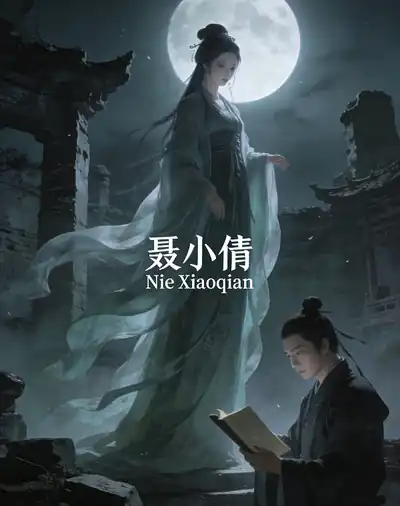
宁采臣宁采臣故事男主角,浙江人,为人正直刚毅,不为财色所动。蒲松龄笔下"义士"典范。,浙人。性慷慨,廉隅自重。每对人言:「生平无二色。」适赴金华,至北郭,解装兰若寺中。寺中殿塔壮丽,然蓬蒿没人,似绝行踪。
有士人来投,自称燕赤霞燕赤霞剑客,精通法术,能降妖除魔。在故事中是保护宁采臣的关键人物,代表正义的力量。,陕西人。言笑既毕,各归寝所。宁以新居,辗转不寐。
忽闻舍北有声,窥之见短墙外一小院落。有妇人年四十许,一媪媪老年妇女的尊称,古文中常见。此处指故事中充当媒人的老妇。,又一女子,夜深月下,低语不止。宁知为鬼魅,然心窃慕之。此后遂有聂小倩聂小倩故事女主角,十八岁病逝,葬于兰若寺旁。被妖物胁迫,以美色诱人、摄人精血,实非本心。之夜访。
Ning Caichen宁采臣 Níng CǎichénThe protagonist, a scholar from Zhejiang, known for his upright character and self-discipline. He represents Pu Songling's ideal of the virtuous gentleman., a man of Zhejiang, was generous by nature, upright and self-respecting. He often declared to others: "In all my life, I have never looked at a second woman." On his way to Jinhua, he stopped north of the city walls and took lodging at Lanruo Temple兰若寺 Lánruě SìThe ruined temple where the story takes place. "兰若" derives from the Sanskrit "aranya," meaning a quiet, secluded place — here turned into a den of ghosts and demons.. The halls and pagodas were magnificent, yet overgrown with weeds, as though no living soul had passed there in years.
A scholar came to stay, calling himself Yan Chixia燕赤霞 Yàn ChìxiáA swordsman versed in Daoist arts, capable of vanquishing demons. He serves as Ning Caichen's protector against the forces of evil., from Shaanxi. After pleasantries, each retired. Ning, unused to his quarters, tossed and turned, unable to sleep.
Suddenly he heard voices from the north side of his room. Peering over the low wall, he saw a small courtyard. A woman of about forty, an old crone媪 ǎoAn honorific for an elderly woman, common in classical Chinese. Here she serves as a matchmaker for the ghost., and a young woman whispered together beneath the moon. Ning knew they must be ghosts, yet his heart secretly stirred. And so began the nightly visits of Nie Xiaoqian聂小倩 Niè XiǎoqiànThe heroine, who died of illness at eighteen and was buried near the temple. Forced by a demon to seduce travelers and drain their life force, she acts against her true nature..
宁以新居,辗转不寐。忽闻舍北喁喁,如有家口。起伏北壁石窗下,微窥之。见短墙外一小院落,有妇人年四十许,又一媪媪老妇,此处充当鬼女的操控者。,衣绯绯红色,常指绯红色的衣物。古代女子多着红衣,此处用以形容女鬼的装束。,插蓬沓,鲐背鲐背指老年人背部弯曲如鲐鱼之背,形容年老体衰。鲐鱼即鲐鱼,背有皱纹。龙钟。偶语曰:「小倩何久不来?」妇人曰:「殆好逑矣。」
媪曰:「姥姥将无向言?」妇人曰:「不意小妮子胆怯。」言未已,有一十七八女子来,仿佛艳绝艳绝美艳至极,无与伦比。"绝"为程度副词,表示"极致"。。媪笑曰:「背地不言人,我两个正谈道,小妖婢悄来无迹响。幸不訾短。」女子曰:「不知何等。」媪顾妇曰:「小娘子端好是画中人。」
宁意其邻人眷口,寝不复听。又许时,始寂无声。方将睡去,觉有人至寝所。急起审顾,则北院女子也。惊问之,女笑曰:「月夜不寐,愿修燕好燕好亲密交好,此处为女子主动求欢的委婉说法。"燕"有安乐之意。。」宁正容曰:「卿当畏人言,稍一失足,廉耻丧尽。」女惧,遂退。
Ning, unaccustomed to his quarters, tossed and turned, unable to sleep. He suddenly heard murmuring from the north side of his room, as if a household lived there. Rising, he peered through a stone window in the north wall. Beyond a short wall lay a small courtyard where a woman of about forty and an old crone媪 ǎoAn elderly woman, here acting as handler for the ghost girl. in crimson绯 fēiScarlet or crimson. Women in ancient China often wore red; here it describes the ghost's attire. robes, her hair piled high, her back bent like an aged fish鲐背 tái bèiDescribing a back bent with age, like the ridged spine of a mackerel — an elegant way to say "decrepit.", were whispering together. The crone asked: "Why has Xiaoqian not come?" The woman replied: "Perhaps she has found a lover."
The crone said: "The Old Mother may have spoken to her?" The woman said: "I never thought the girl so timid." Before she finished, a girl of seventeen or eighteen appeared — stunningly beautiful艳绝 yàn juéBeautiful beyond compare. "绝" is an intensifier meaning "to the utmost.". The crone laughed: "We were just speaking of you behind your back! How fortunate you did not overhear us slandering you." The girl said: "I heard nothing." The crone looked at the woman: "This young lady is truly a painting come to life."
Ning assumed they were a neighbor's family and lay down to sleep. After a while, silence fell. Just as he was dozing off, he sensed someone enter his room. He leaped up to see — it was the girl from the north courtyard. Alarmed, he asked who she was. She smiled: "On this moonlit sleepless night, I wished to keep you company燕好 yàn hǎoIntimate companionship — a euphemism for romantic union. "燕" conveys ease and pleasure.." Ning straightened his face and said: "You should fear what others might say. One misstep and your reputation is ruined beyond recall." The girl, frightened, withdrew.
次日一更许,女又来,曰:「妾阅人多矣,未有刚肠如君者。君诚圣贤,妾不敢欺。妾聂小倩聂小倩十八岁夭亡,葬于兰若寺旁。被妖物驱使,以色诱人、摄人精血为事。,十八夭殂,葬寺旁。被妖物威胁,历役贱务。」言毕悲泣。宁问:「何物?」曰:「即寺中老魅老魅年老的妖魅,此处指控制兰若寺的千年老妖,以鬼女为工具害人。也。」
宁惧,求计。女曰:「与燕生同室可免。」宁问:「何以不惑燕生?」曰:「彼奇人也,不敢近。」又曰:「妾以美人计,无不中。然君子不以金帛金帛金银与丝织品的合称,泛指财物。此处小倩揭示妖物所用之计:先以财诱,再以色诱。动者,又以夜叉相逼。今寺中无可杀之人,恐当以夜叉来。」
宁求之曰:「仆何术可以避之?」女曰:「惟剑仙可敌。君可与燕生居,或可免。」临别泣曰:「妾堕堕坠落,陷入。此处指小倩被迫堕入妖物的掌控,身不由己。入幽冥,实非所愿。君若不弃,望收妾朽骨,葬于清净之地。」宁毅然诺之。
The following night, near the second watch, the girl returned. "I have seen many men," she said, "but none with a spirit as unbending as yours. You are truly a sage — I dare not deceive you any longer. I am Nie Xiaoqian聂小倩 Niè XiǎoqiànDied young at eighteen, buried near the temple. Forced by an evil spirit to seduce men and drain their life essence.. I died at eighteen and was buried beside this temple. A demon has been forcing me to perform these vile tasks." She wept bitterly. Ning asked: "What creature is it?" She answered: "The old fiend老魅 lǎo mèiThe ancient demon controlling Lanruo Temple, using ghost girls as tools to kill travelers. who rules this temple."
Ning, afraid, asked how to protect himself. She said: "Share a room with Master Yan and you may be spared." Ning asked: "Why does the demon not bewilder Yan?" She replied: "He is no ordinary man — the demon dare not approach him." She added: "The demon's beauty trap has never failed. Yet you gentleman cannot be moved by gold and silk金帛 jīn bóA collective term for riches — gold and fine fabrics. Xiaoqian reveals the demon's strategy: first tempt with wealth, then with beauty., and next they will send a yaksha to kill you."
Ning begged: "What art can protect me?" She answered: "Only a sword immortal can fight them. If you dwell with Master Yan, you may survive." At parting she wept: "I sank堕 duòTo fall, to sink into. Xiaoqian was dragged into the netherworld against her will. into the realm of shadows not by choice. If you do not scorn me, I beg you — gather my poor bones and bury them in a clean and peaceful place." Ning solemnly vowed he would.
宁乃托燕往他处,密于寺后寺后寺庙的后面。宁采臣按照聂小倩的指示,在寺庙后方找到了她的坟墓,起出朽骨。得荒冢,有白杨树,树上有乌巢。宁发其骨殖骨殖死者的遗骨。"殖"为"骨"的后缀,无实义。,用衣裹之,携归营葬。祝曰:「怜卿孤魂,葬近蜗居,歌哭相闻,庶不见凌于雄鬼。」
至家,葬之斋前。祝曰:「魂如有灵,勿见侵扰。」后宁读书斋中,小倩每至。初犹不敢久留,渐而留之。宁知其无他,亦不之防。
一日,宁将赴试,小倩曰:「妾从君行。」宁曰:「途中不便。」小倩曰:「妾昼伏夜出,与君偕行,亦无所害。」宁遂携之。行数日,至家。入拜太夫人,太夫人愕眙愕眙惊愕地瞪大眼睛。"愕"为惊讶,"眙"为直视。此处形容宁母初见聂小倩时的震惊。,以其非人,勿许。小倩曰:「儿实非鬼,乃一魂魄。因感君义,愿侍巾栉。」
太夫人察其温婉,乃许之。小倩朝旦朝母,下堂操作,不辞劳苦。居久之,渐能日中行。后竟产一男。又数年,宁登进士进士科举考试最高功名。宁采臣金榜题名,聂小倩也从鬼逐渐变为人,象征着爱情超越生死的力量。,小倩举一男。人皆异之。
Ning, having enticed Master Yan to go elsewhere, secretly went behind the temple寺后 sì hòuBehind the temple. Following Xiaoqian's directions, Ning found her grave there and exhumed her bones.. There, among white poplars, with crows nesting above, he found the neglected grave. He unearthed her bones骨殖 gǔ shiThe bones of the dead. "殖" is a suffix with no independent meaning., wrapped them in cloth, and carried them home to rebury. He prayed: "I pity your lonely spirit. I bury you near my humble home, so that my songs and weeping may be heard, and no malevolent ghost may torment you."
At home, he buried her before his study. He prayed: "If your spirit has awareness, let no harm come to you." Thereafter, whenever Ning read in his study, Xiaoqian would come. At first she dared not linger; gradually she stayed longer. Knowing she meant no harm, Ning let down his guard.
One day, when Ning was about to set off for the imperial examinations, Xiaoqian said: "I wish to go with you." Ning said: "The road would be inconvenient." She replied: "I sleep by day and travel by night — to journey with you would cause no trouble." So Ning took her along. After several days they arrived at his home. She entered and bowed to the old mother, who stared in shock愕眙 è chìTo stare in astonishment. "愕" means startled; "眙" means to gaze fixedly., sensing she was no mortal, and refused to accept her. Xiaoqian said: "I am no ghost, but a spirit. Moved by your son's righteousness, I wish to serve this household."
The old mother, seeing her gentle demeanor, relented. Xiaoqian rose each dawn to attend the old mother, labored in the house without complaint. After some time, she could walk in daylight. Eventually she bore a son. Years later, Ning passed the jinshi进士 jìn shìThe highest degree in the imperial examination. Ning's success and Xiaoqian's transformation from ghost to human symbolize love's power to transcend death. examinations, and Xiaoqian bore another son. All who heard of it marveled.
鬼比人更有人性
《聂小倩》是蒲松龄最精妙的人鬼之恋叙事之一。与传统鬼故事中"鬼害人、人驱鬼"的二元对立不同,蒲松龄颠覆了善恶的归属:鬼女小倩虽受妖物驱使,却心存善念,主动警告宁采臣;而"人"的世界中,老妖与夜叉反而更加残暴无情。这种"鬼有人性、人比鬼恶"的反转,是蒲松龄最核心的文学立场。
小倩的转变过程极具象征意义:从夜间的鬼魅,到能够在日光下行走,再到生育后代——她从"鬼"逐渐变"人",而这个转变的动力不是法术,而是宁采臣的正直与接纳。蒲松龄以此暗示:真正的"人性"不是肉身的属性,而是道德的选择。一个鬼,只要选择了善,便胜过千万行恶之人。
比较研究
与西方鬼故事相比(如《呼啸山庄》中的凯瑟琳之魂),聂小倩的"鬼魂"身份并非悲剧的根源,而是社会压迫的隐喻。蒲松龄笔下的女鬼往往是被迫堕落的弱者,她们的"鬼性"来自外在的压迫而非内在的邪恶。这一主题与《聊斋》中大量"狐女"故事一脉相承——非人女性往往比人类女性更自由、更忠诚、更有情义。
Ghosts Are More Human Than Humans
"Nie Xiaoqian" is one of Pu Songling's most masterful ghost-love narratives. Unlike traditional ghost stories with their rigid binary of "ghosts harm, humans exorcise," Pu inverts the moral order: though Xiaoqian is compelled by a demon, her heart retains goodness — she warns Ning Caichen of danger. Meanwhile, the "human" world houses the old fiend and yaksha, far more cruel and merciless. This reversal — ghosts possessing humanity while humans surpass ghosts in wickedness — is Pu Songling's essential literary stance.
Xiaoqian's transformation is richly symbolic: from a night-wandering ghost, to one who can walk in sunlight, to a mother bearing children — she gradually becomes "human." The force behind this change is not sorcery but Ning Caichen's integrity and acceptance. Pu implies that true "humanity" is not a property of flesh but a moral choice. A ghost who chooses goodness surpasses ten thousand humans who choose evil.
Comparative Study
Compared with Western ghost stories (such as Catherine's ghost in Wuthering Heights), Xiaoqian's spectral nature is not the source of tragedy but a metaphor for social oppression. Pu's female ghosts are often unwilling victims forced into corruption — their "ghostliness" comes from external coercion, not inner evil. This theme runs through the Liaozhai fox-spirit tales as well: non-human women are frequently freer, more loyal, and more emotionally genuine than their human counterparts.
蒲松龄笔下的理想书生形象。他"性慷爽,廉隅自重",面对女鬼的诱惑不为所动,面对妖物的威胁不改初心。宁采臣的形象代表了蒲松龄对知识分子道德人格的最高期许:正直而不迂腐,仁义而不怯懦。后世影视改编中,宁采臣与聂小倩的故事被反复搬上银幕,最著名的版本是1987年张国荣主演的《倩女幽魂》。
Pu Songling's idealized scholar. "Generous, upright, self-respecting" — he neither succumbs to the ghost's seduction nor abandons his principles under threat. Ning embodies Pu's highest moral standard for intellectuals: righteous without being rigid, courageous without being reckless. The story has been adapted countless times for film, most famously in the 1987 film A Chinese Ghost Story starring Leslie Cheung.
聂小倩是《聊斋志异》中最动人的女鬼形象之一。她十八岁夭亡,葬于荒寺之旁,被千年妖物驱使,以色诱人、摄人精血。然而她始终保有人性的良知——主动警告宁采臣,并请求收骨改葬。蒲松龄赋予她的转变极富深意:从夜间活动的鬼魅,到能在日光下行走,再到生儿育女——她的"人化"过程象征着道德选择对命运的超越。
One of the most moving ghost-heroines in all of Chinese literature. Dead at eighteen, buried near a desolate temple, she is enslaved by a thousand-year-old demon to seduce and drain travelers. Yet she preserves her conscience — warning Ning Caichen and begging for her bones to be reburied. Her gradual transformation from night-dwelling spirit to sunlight-walking mortal to mother symbolizes the triumph of moral choice over fate.
"兰若"源自梵语"阿兰若"(aranya),意为寂静处、修行之所。蒲松龄以此命名荒寺,颇具反讽意味:一个本应清净修行的地方,却成了妖物盘踞、鬼女出没的凶险之所。这种"名不副实"的设计,暗示了世间正邪的颠倒——打着神圣旗号的地方,往往是罪恶的巢穴。
"Lanruo" derives from the Sanskrit "aranya," meaning a quiet place of spiritual practice. Pu's ironic naming is pointed: a place that should be a sanctuary of purity has become a lair of demons and trapped spirits. This inversion — sacred names hiding profane realities — is a recurring motif in Pu's social criticism.
清代蒲松龄(1640—1715)所著文言短篇小说集,共四百九十一篇。"聊斋"为蒲松龄的书斋名,意为"姑且闲聊之所";"志异"意为记录奇闻异事。全书以狐鬼花妖为载体,实则针砭时弊,寄托孤愤。蒲松龄一生科举不第,却以这部作品成为中国文言小说的巅峰。郭沫若评曰:"写鬼写妖高人一等,刺贪刺虐入骨三分。"
A collection of 491 classical-language short stories by Pu Songling (1640–1715). "Liaozhai" (Chatting Studio) was the name of his study; "Zhiyi" means "records of the strange." Beneath its surface of fox spirits and flower demons lies biting social commentary and the author's lifelong frustration with the imperial examination system. Guo Moruo praised it: "In writing of ghosts and demons, he surpasses all others; in satirizing greed and tyranny, he strikes to the bone."