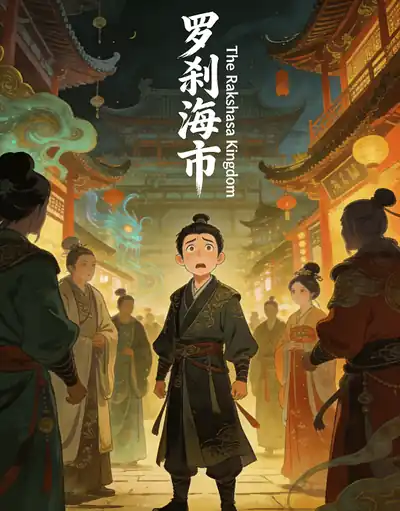
马骥马骥字龙媒,商人之子,貌美善歌舞。因海难漂流至罗刹国,以丑为美的世界中反被视为丑人。后涂面自污,反而声名大振。,字龙媒龙媒马骥的表字。"龙媒"典出《汉书》,原指骏马,引申为能引来贤才的人。马骥以龙媒为字,暗含"千里马"之意,讽刺他在罗刹国却因貌美而不得志。,贾人子。美丰姿,少倜傥,喜歌舞。辄从梨园子弟,以锦帕缠头,美如好女,因复有「俊人」之号。
十四岁入郡庠郡庠地方官学。"庠"是古代学校的名称,"郡庠"即郡一级的学校。马骥本可走科举之路,却因父亲之命从商。,即知名。父衰老,罢贾而归。谓生曰:「数卷书,饥不可煮,寒不可衣。吾儿可仍继父贾。」
马由是稍稍权子母。从人浮海,为飓风飓风强烈的海上风暴。古代航海者最畏惧的灾难之一。此处飓风将马骥吹到了一个完全陌生的世界。引去,数昼夜至一都会。其人皆奇丑,见马至,以为妖,群哗而走。
Ma Ji马骥 Ma JiCourtesy name Longmei, son of a merchant. Handsome and talented in song and dance. Shipwrecked on the Land of Rakshasas, he is deemed ugly in a world that inverts beauty standards. Later, by painting his face dark, he becomes celebrated., whose courtesy name was Longmei龙媒 Lóng MéiMa Ji's courtesy name. "Longmei" alludes to the Han History, originally meaning a fine steed — one who attracts talent. The name is ironic: a "thoroughbred" who is rejected for his beauty in the Rakshasa land., was the son of a merchant. Handsome in bearing, dashing in youth, fond of song and dance. He would follow the opera performers, head wrapped in brocade, beautiful as a lovely girl — earning the nickname "the Fair One."
At fourteen he entered the district school郡庠 jùn xiángA local government school. "Xiáng" is an ancient term for a school; "jùn xiáng" means a school at the commandery level. Ma Ji might have pursued the civil examinations, but his father steered him toward trade. and quickly made a name. When his father grew old and retired from business, he said to his son: "A few volumes of books — they cannot be boiled for hunger nor worn against the cold. My son, you had best follow your father's trade."
Ma thus began to invest and trade. He sailed with others across the sea, but a hurricane飓风 jù fēngA devastating sea storm, one of the greatest terrors of ancient seafarers. Here the hurricane drives Ma Ji to an entirely unknown world. seized the vessel. After days and nights of drifting, he arrived at a great city. Its people were all hideously ugly. Seeing Ma, they took him for a monster and fled in panic.
马初见之,亦惧。后渐饲饲喂养、投食。此处用"饲"而非"食",暗示当地人起初将马骥视为动物或怪物,只是远远投食给他,不敢靠近。之。马问其何以见惧。曰:「尝闻祖父言:西去二万六千里,有中国中国此处指中原地区,即华夏文明的核心区域。在罗刹国人眼中,"中国"的人长相怪异,与中国人看罗刹国人丑陋形成镜像对称。,其人民多诡诡奇异、怪异。此处罗刹国人以"诡"来形容中国人——在他们看来,五官端正、面目清秀反而是怪异的。状。今信然。」
马以此安安安定、安心。此处指马骥明白了自己被惧怕的原因后反而安心了——原来不是自己有问题,而是审美标准不同。之。渐与之习,始知其国所重,不在文章,而在形貌。其美之极者为上卿;次则任民社;下焉者,亦邀贵人宠,故鼎食以终。
马问其何以为美。曰:「以面黑、鼻陷、须卷、齿露为美。」马曰:「此在中国,皆丑状也。」其人曰:「各有所好,君不知耶?」
At first Ma was frightened himself. Gradually they began to feed him from a distance饲 sìTo feed or nourish. The use of "sì" rather than a word meaning "to offer food to a guest" implies the locals treated Ma Ji as an animal or monster at first, tossing food toward him without daring to approach.. Ma asked why they feared him. They said: "Our ancestors told us: twenty-six thousand li to the west, there is the Middle Kingdom中国 Zhōng GuóHere meaning the Central Plains — the heartland of Chinese civilization. To the Rakshasa people, the "Middle Kingdom's" people look monstrous, mirroring how Chinese view the Rakshasa as ugly — a perfect inversion., whose people have strange诡 guǐPeculiar, monstrous. Here the Rakshasa people use "guǐ" to describe the Chinese — in their eyes, regular features and a handsome face are the very definition of the grotesque. features. Now we believe it."
Ma was thus reassured安 ānTo feel at ease. Ma Ji realizes he is feared not because something is wrong with him, but because beauty standards are simply different — and he is relieved.. As he grew accustomed to them, he learned that what their nation valued was not literary talent, but physical appearance. The most hideous served as chief ministers; the moderately ugly held local offices; even the least ugly enjoyed noble patronage and feasted to the end of their days.
Ma asked what they considered beautiful. They said: "Dark skin, sunken nose, curled beard, and protruding teeth — these are beauty." Ma said: "In the Middle Kingdom, these would all be signs of ugliness." They replied: "Each to his own taste — do you not know that?"
马曰:「然则何以处我?」曰:「君虽不甚丑,然须涂面涂面在脸上涂抹颜料以改变容貌。马骥为了在罗刹国生存,不得不将自己俊美的面容涂黑,扮成"丑人"。这是对社会审美霸权的深刻讽刺。,庶几可近贵人。」马曰:「吾不愿以伪面目求荣。」
久之,马渐与国人习。饮酣,马起舞,亦效作弋阳腔弋阳腔明代四大声腔之一,源于江西弋阳,以高亢激越为特点。马骥以此取悦当地人,却因此被视为异类,反而被疏远。以为乐。国人见之,益以为异。皆惧。
有执戟郎者,亦丑,见马而异之。曰:「君面貌非此间人,何以至此?」马具道所以。执戟郎大悦,延至家,与之饮。马自愧雕虫雕虫"雕虫小技"的略语,指微不足道的技艺。典出扬雄《法言》:"雕虫篆刻,壮夫不为。"此处马骥以自己的文才为"小技",因为在罗刹国一切以貌取人。之技,不敢言文。
居数月,执戟郎引马入朝。马涂面如张飞张飞三国时期蜀汉名将,以豹头环眼、燕颔虎须著称。马骥将自己涂成张飞的模样,这既是自嘲,也是对"以丑为美"的极致回应。,遂拜为下大夫。
Ma said: "Then how shall I be regarded?" They replied: "Though you are not very ugly, you must paint your face涂面 tú miànTo apply pigment to the face and alter one's appearance. Ma Ji must darken his handsome features to survive in the Rakshasa land — a biting satire on society's monopoly over beauty., and then perhaps you may approach the nobles." Ma said: "I will not seek honor behind a false face."
In time, Ma grew familiar with the people. After drinking, he rose to dance and sang in Yiyang style弋阳腔 Yìyáng qiāngOne of the four great vocal styles of the Ming dynasty, originating in Yiyang, Jiangxi, known for its bold and stirring quality. Ma Ji's performance delights the locals yet marks him as alien, driving them further away. for amusement. The people, seeing this, found him stranger still and drew away in fear.
A halberdier, himself ugly, regarded Ma with wonder. "Your face is not of this world — how came you here?" Ma told his story. The halberdier was overjoyed, invited him home, and drank with him. Ma, ashamed of his "minor skill"雕虫 diāo chóngAn abbreviation of "carving insects and minor crafts" — trivial arts. From Yang Xiong's Fayan: "Carving insects and engraving seals — no grown man does these." Ma Ji demotes his own literary talent to "minor skill" because in this land, only looks matter., dared not speak of literature.
After several months, the halberdier brought Ma before the court. Ma painted his face like Zhang Fei张飞 Zhāng FēiA famous general of Shu-Han in the Three Kingdoms period, known for his leonine face and fierce beard. Ma Ji paints himself in Zhang Fei's image — both self-mockery and the ultimate response to "ugliness as beauty.", and was appointed a minor court official.
马居罗刹久,意忽忽不乐。一日,有海上人来,言海市海市即海市蜃楼,但此处并非光学幻象,而是龙宫定期开放的真实市场。海市与罗刹国形成鲜明对比——一个是颠倒美丑的荒诞世界,一个是美与财富的理想国。甚盛。马请与俱往。
至则海水壁立,如万仞之城。中有楼台,鳞次栉比。市中珍宝山积,玳瑁玳瑁海龟的一种,其甲壳花纹美丽,自古被视为珍贵装饰材料。此处与珊瑚、琥珀并列,描绘海市的奢华富丽。为梁,珊瑚作树,琥珀琥珀树脂化石,色泽金黄透明,中国古代视为珍宝。常用于制作饰品和药材。砌阶。
一人乘龙出,龙鳞灿烂,与马相见。自言:龙君龙君龙王,即东海龙宫之主。与罗刹国的荒谬统治者形成对比,龙君代表理想化的贤明君主。也。邀入宫,以女妻之。女美而才,与马相得甚欢。
居岁余,马思归。龙君赠以珠宝,遣之还。马归家,父母尚在。出珠示人,皆连城连城价值连城,形容极其珍贵。典出"完璧归赵"的故事。马骥从龙宫带回的珠宝价值巨大,足以改变他的命运。之宝也。马遂为巨富。
Ma had lived long in the Rakshasa land and felt troubled at heart. One day a seafarer came and spoke of a Sea Market海市 hǎi shìThe Sea Market — literally "sea marketplace." Not a mirage, but a real market held periodically in the Dragon King's realm. It forms a stark contrast to the Rakshasa land: one inverts beauty into ugliness, the other is a utopia of beauty and wealth. of great splendor. Ma asked to go along.
Upon arrival, the sea rose like walls, a city of ten thousand ren. Within stood towers and terraces row upon row. The marketplace heaped treasures like mountains — hawksbill turtle shell玳瑁 dài màoFrom a species of sea turtle, whose beautiful shell has been prized as an ornamental material since antiquity. Listed here alongside coral and amber to evoke the Sea Market's opulence. for beams, coral for trees, amber琥珀 hǔ pòFossilized resin, golden and translucent, treasured in ancient China for ornaments and medicine. for steps.
A man rode out upon a dragon, its scales shimmering, and greeted Ma. He declared himself the Dragon Lord龙君 lóng jūnThe Dragon King, ruler of the Eastern Sea palace. In contrast to the absurd rulers of the Rakshasa land, the Dragon Lord represents an idealized, enlightened sovereign.. He invited Ma into his palace and gave him his daughter's hand. The daughter was beautiful and talented, and the two lived in perfect harmony.
After a year, Ma longed for home. The Dragon Lord bestowed jewels upon him and sent him back. Ma returned to find his parents still living. When he showed the pearls to others, every one was a treasure beyond price连城 lián chéng"Worth a string of cities" — priceless. From the story of the intact jade returned to Zhao. The Dragon King's gifts made Ma fabulously wealthy.. Ma became a man of great fortune.
双世界结构:讽刺的两面
蒲松龄在《罗刹海市》中构建了两个截然相反的世界:罗刹国以丑为美,海市以美为美。前者是现实社会的变形镜——科举时代不以才学取人、以貌取人的荒谬被放大到了极致;后者是理想世界的乌托邦——龙宫中美与才兼备,一切井然有序。
马骥在这两个世界中的遭遇恰好相反:在罗刹国,他的美貌被视为丑陋,才华毫无用处;在海市,他的美貌和才艺被欣赏,获得了爱情和财富。这种对照揭示了蒲松龄的核心批判:社会的价值判断往往是颠倒的、荒谬的。
当代复兴
2023年,歌手刀郎以《罗刹海市》为题创作歌曲,引发了广泛的社会讨论。这首歌将蒲松龄的讽刺精神移植到当代语境,引发了人们对"以丑为美"、"颠倒是非"等社会现象的共鸣。这证明了《聊斋志异》作为文学经典的永恒生命力——三百年前的讽刺,至今仍然切中时弊。
Dual-World Structure: Two Faces of Satire
Pu Songling constructs two diametrically opposed worlds: the Rakshasa Land, where ugliness is beauty, and the Sea Market, where beauty is beauty. The former is a distorting mirror of real society — the absurdity of judging people by appearance rather than talent, magnified to its logical extreme. The latter is a utopia — the Dragon Palace, where beauty and talent coexist in perfect order.
Ma Ji's experiences in these two worlds are mirror images: in the Rakshasa land, his beauty is deemed ugly and his talent useless; in the Sea Market, his looks and gifts are admired, and he gains love and wealth. This contrast reveals Pu Songling's core critique: society's value judgments are often inverted and absurd.
Contemporary Revival
In 2023, singer Dao Lang released a song titled "Luosha Haishi," sparking widespread social discussion. The song transplants Pu Songling's satirical spirit into a contemporary context, resonating with audiences' experiences of "ugliness celebrated as beauty" and "truths inverted." This demonstrates the timeless vitality of Strange Tales as a literary classic — satire written three hundred years ago that still strikes home today.
"罗刹"源自梵语Rākṣasa,是印度神话中食人的恶魔,形象丑恶。蒲松龄以此命名一个"以丑为美"的国度,暗示整个社会的审美标准已被魔化。"海市"即海市蜃楼,但在此并非虚幻,而是龙宫的真实集市——理想之境是真实的,荒诞的反而是人间。这个标题本身就包含了故事的核心张力:魔界与仙境、荒诞与理想的对比。
"Luó Chà" derives from the Sanskrit Rākṣasa — flesh-eating demons of Indian mythology, hideous in form. Pu Songling names the "ugliness-is-beauty" kingdom after them, implying the entire society's aesthetics have been demonized. "Hǎi shì" means a mirage over the sea, but here it is no illusion — it is a real marketplace in the Dragon Palace. The ideal realm is real; it is the human world that is absurd. The title itself contains the story's core tension: the demonic versus the divine, the absurd versus the ideal.
马骥字龙媒。"龙媒"语出《汉书·礼乐志》:"天马徕,龙之媒。"意为天马是龙的媒介,引申为千里马、英才。蒲松龄以"龙媒"为马骥的字,暗含对"千里马常有,而伯乐不常有"的感叹。在罗刹国这个颠倒的世界里,千里马反被视为劣马——正如怀才不遇的文人在腐败的社会中被埋没。
Ma Ji's courtesy name Longmei comes from the Han History: "The heavenly steed comes — the dragon's match." It means a fine horse is the dragon's equal, extending to mean a thoroughbred or genius. Pu Songling's choice of name echoes the lament: "Thoroughbreds are common; those who can recognize them are rare." In the inverted world of the Rakshasa, the thoroughbred is taken for a nag — just as talented scholars are buried in a corrupt society.
"以丑为美"是《罗刹海市》的核心命题。在罗刹国,审美标准被完全颠倒:面目狰狞者为上卿,五官端正者被视为妖怪。蒲松龄借此讽刺当时社会中真才实学不敌钻营逢迎、品德高尚不如谄媚权贵的现实。"以丑为美"不仅是审美层面的颠倒,更是整个价值体系的倒错——当社会以错误的标准衡量一切,真正有价值的东西反而被弃如敝履。
"Ugliness as beauty" is the core thesis of the story. In the Rakshasa land, aesthetic standards are completely inverted: the hideous become ministers, while the regular-featured are seen as monsters. Pu Songling satirizes a society where genuine talent loses to sycophancy, and moral integrity is worth less than flattering the powerful. "Ugliness as beauty" extends beyond aesthetics to the entire value system: when society measures everything by wrong standards, what is truly valuable is discarded like worn shoes.
清代蒲松龄所著文言短篇小说集,凡四百九十一篇。全书借狐鬼仙怪的故事反映社会现实,文字典雅精练,讽刺深刻犀利。《罗刹海市》是其中最具社会批判力的篇章之一,以奇幻的外壳包裹着对现实世界的尖锐讽刺。鲁迅评价蒲松龄"用传奇法,而以志怪",指出了他将唐传奇的叙事技巧与志怪传统相结合的独创性。
A collection of 491 classical Chinese short stories by Qing-dynasty author Pu Songling. Through tales of fox spirits, ghosts, and immortals, it mirrors social reality with elegant, incisive prose. "The Land of Rakshasas and Sea Market" is among its most socially critical pieces, wrapping sharp satire in a fantastical shell. Lu Xun praised Pu Songling for "using the romance method to record the strange," noting his unique fusion of Tang-dynasty narrative techniques with the supernatural tradition.