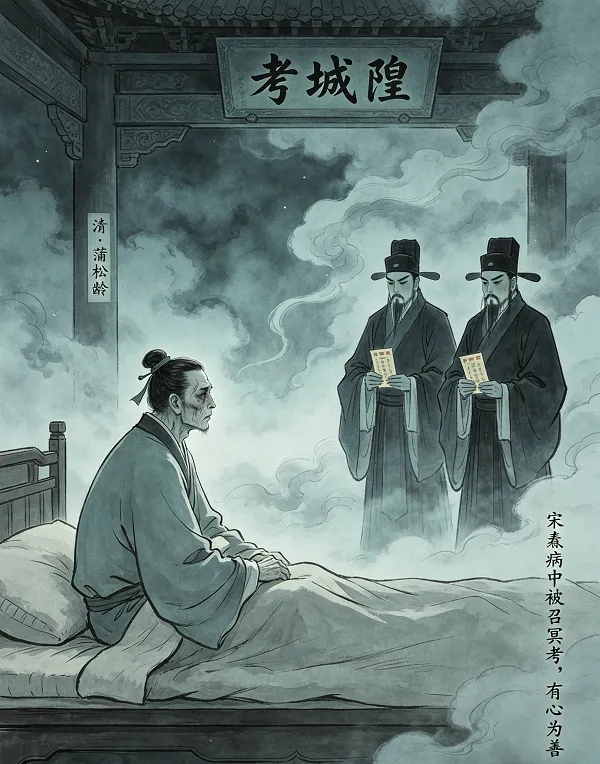
予姊丈之祖宋公,名焘,邑廪生廪生明清时期,秀才中成绩优异者可领取官府发放的膳食补贴(廪膳),称为"廪生",是生员中的最高等级。。一日,病卧,见一吏持牒来,牵白颠马,云:「请赴试。」公曰:「文宗未临,何试?」吏但催之。
公力疾乘马从之。路甚生疏,至一城郭,如王者都王者都帝王的都城。形容城池宏伟壮丽,如同人间帝王的京城一般,暗示宋焘所到之处非同寻常。。移时,入府廨,宫室壮丽。上坐十余官,都不知何人,惟关壮缪可识。
檐下设几墩墩坐墩,一种矮而圆的坐具。古时考试时在坐墩上放几案(小桌),考生伏案作答。此处冥界考试的布置完全仿照人间科举。各一。先有一秀才坐其末,公便与连肩连肩肩并肩而坐。形容两位考生并排就坐,如同人间科举考场中相邻而坐的考生。。几上各有笔札。
The grandfather of my brother-in-law was a man named Song Tao, a stipendary scholar廪生 lǐn shēngIn Ming-Qing times, top-performing licensed scholars received government stipends for food. These "stipendary scholars" ranked highest among students — a mark of distinction. of the district. One day, as he lay ill in bed, he saw an official approach holding a document, leading a white-foreheaded horse. The official said: "You are summoned to the examination." Song said: "The examiner has not arrived — what examination?" The official merely urged him on.
Song mounted the horse with difficulty and followed. The road was utterly unfamiliar. They arrived at a walled city, grand as an imperial capital王者都 wáng zhě dūA royal capital — the phrase signals that Song Tao has entered a realm of supreme authority, far beyond any earthly city.. After a time, they entered a government compound with magnificent halls. Seated above were a dozen officials, none of whom Song recognized — save for Lord Guan, whom he could identify.
Beneath the eaves were set stools墩 dūnRound, low stools. In imperial examinations, these supported small desks at which candidates wrote their answers. The underworld exam replicates the earthly testing hall exactly. and desks, one pair per person. A scholar was already seated at the far end, and Song sat beside him连肩 lián jiānShoulder to shoulder — as in an earthly examination hall where candidates sit side by side at adjacent desks.. On each desk lay brush and paper.
俄题纸飞下。视之,八字:「一人二人一人二人字面意思是一个人两个人,实为哲学命题:如何理解"人"的本性?是独善其身还是兼济天下?这是典型的科举策论题,要求考生阐发义理。,有心无心。」二公文成,呈殿上。公文中有云:「有心为善有心为善刻意地去做善事。"有心"指有意为之、有目的性。宋焘认为,带有目的的善行不应被奖赏,因为其中混杂了功利之心。,虽善不赏;无心为恶,虽恶不罚。」
诸神传赞不已。召公上,谕曰:「河南缺一城隍,君称其职。」公方悟,稽颡稽颡磕头至地,古代极重的跪拜礼。比"稽首"更为庄重,额头触地后停留不动,表示极度的感恩或哀痛。泣曰:「辱蒙宠命,何敢多辞!但老母七旬,奉养无人,请终其天年,惟听录用。」
上一帝王像者,即命稽母寿籍。一长髯吏髯吏长着长胡须的官吏。"髯"指两颊上的长须,古人以长髯为威严、智慧的象征。此处长髯吏查阅生死簿,如同人间吏部查阅官员档案。捧册,翻阅一过,曰:「有阳算九年。」
Presently an examination paper fluttered down. On it were eight characters: "One man, two men一人二人 yī rén èr rénLiterally "one person, two persons" — a philosophical riddle about the nature of humanity. Does one cultivate oneself alone, or serve all? This is a classic examination topic requiring moral exposition.; with intention, without intention." Both men completed their essays and presented them above. In Song's essay was written: "When good is done with deliberate intent有心为善 yǒu xīn wéi shànPerforming good deeds purposefully. Song argues that calculated kindness should not be rewarded, as it is tainted by self-interest., though it be good, it shall not be rewarded; when evil is done without intent, though it be evil, it shall not be punished."
The gods passed it around and praised it without end. Song was summoned above, and they said: "Henan Province lacks a City God — you are worthy of the post." Song suddenly understood. He prostrated himself稽颡 qǐ sǎngThe most solemn form of kowtow — forehead pressed to the ground and held still. Even more reverential than 稽首, expressing overwhelming gratitude or grief. and wept: "I dare not refuse so gracious an appointment! But my aged mother is seventy, with no one to care for her. Grant me to serve out her natural lifespan — then I shall submit to your command."
A figure resembling an emperor ordered the registers of her lifespan checked. A long-bearded clerk髯吏 rán lìAn official with a flowing beard — in Chinese culture, long whiskers symbolize authority and wisdom. This clerk consults the Book of Life and Death as a civil servant would check personnel files. brought forth a ledger and leafed through it. He said: "She has nine years of life remaining in the world of the living."
公文成,呈殿上。公文中有云:「有心为善,虽善不赏;无心为恶,虽恶不罚。」诸神传赞不已。召公上,谕曰:「河南缺一城隍,君称其职。」
公方悟已死,稽颡泣曰:「辱蒙宠命,何敢多辞!但老母七旬,奉养无人,请终其天年,惟听录用。」旁一帝王像者,即命稽母寿籍。长髯吏捧册翻阅,曰:「有阳算阳算阳间的寿命。"算"指命运的计算,"阳算"即在人间尚余的寿命年数。生死簿上记录每个人在阳间的剩余寿命。九年。」
公闻之,泣曰:「母亲年迈,无人侍奉。请赐九年之假,使得尽人子之心。待母寿终,即当赴任。」诸神相顾,叹曰:「孝子!」即命送之还。又曰:「此九年,当勉修德业勉修德业努力修养道德与学问。"勉"是勉励、努力,"修"是修养、修炼。冥界准假的同时也提出了道德要求,体现了"以德取士"的核心理念。,勿负此命。」
When the essays were complete, they were presented to the assembly. Song's essay contained the lines: "When good is done with deliberate intent, though it be good, it shall not be rewarded; when evil is done without intent, though it be evil, it shall not be punished." The gods passed it around and praised it endlessly. They summoned Song forward and declared: "Henan lacks a City God — you are fit for the post."
Song then understood he had died. He prostrated himself稽颡 qǐ sǎngThe deepest form of kowtow — forehead touching the ground, expressing absolute sincerity. and wept: "I dare not refuse so gracious an appointment! But my aged mother is seventy, with no one to care for her. Grant me to see out her natural years, and then I shall obey your command." A figure like an emperor ordered her lifespan checked. The bearded clerk consulted the registers and said: "She has nine years remaining阳算 yáng suànRemaining years of life in the mortal world. "算" refers to the calculus of fate; the registers record exactly how long each person has yet to live.."
Song wept: "My mother is aged, with no one to serve her. Grant me a leave of nine years, that I may fulfill a son's devotion. When her lifespan ends, I shall take up my post." The gods looked at one another and sighed: "A filial son!" They ordered him returned to the living. They added: "In these nine years, strive to cultivate virtue and learning勉修德业 miǎn xiū dé yèTo diligently nurture moral character and scholarly achievement. The leave comes with a condition — reflecting the principle that official appointment must be grounded in personal virtue. — do not辜负 this charge."
公乃辞归。及里门,豁然苏苏苏醒、复活。从冥界回到阳间的过程称为"苏",即灵魂回到肉体,恢复知觉。此处宋焘从冥界科举考场回到家中病榻上。。则已死三日矣。母闻棺中呻吟,扶出,半日始能言。遂述所历。至城隍庙视之,果如所言。
后九年,母果卒。公营葬毕,沐浴沐浴洗浴净身。古人在重大仪式前必须沐浴斋戒,表示对神灵的尊敬。此处宋焘沐浴后平静赴死,如同赴任就职一般庄重从容。更衣而卒。岳家城隍庙中,公像忽自鸣,声闻数里。人皆异之。
异史氏曰:「有心为善,虽善不赏;无心为恶,虽恶不罚。」闻此语者,当与之共勉共勉互相勉励。蒲松龄以"异史氏"自称,在篇末点明全篇核心教义,邀请读者共同以这一道德标准要求自己。矣。此冥司之所以重读书人也。
Song took his leave and returned. When he reached his gate, he awoke苏 sūTo revive, to come back to life. Returning from the netherworld to the living is called "苏" — the soul re-entering the body. Song awakes on his sickbed at home. with a gasp. He had been dead for three days. His mother heard groaning from the coffin and helped him out. It was half a day before he could speak. He recounted everything he had witnessed. When they visited the City God's temple, it was exactly as he had described.
Nine years later, his mother indeed passed away. Song arranged the funeral, then bathed and changed沐浴 mù yùBathing and purifying oneself. Before sacred rites, the ancients bathed and fasted to show reverence. Song bathes and calmly goes to his death — as dignified as going to take office. his garments and died. In the City God's temple of his father-in-law's district, Song's statue suddenly began to sound on its own, the noise heard for miles. All who heard it were amazed.
The Historian of the Strange remarks: "When good is done with deliberate intent, though it be good, it shall not be rewarded; when evil is done without intent, though it be evil, it shall not be punished." Those who hear these words should strive together共勉 gòng miǎnTo encourage one another. Pu Songling, calling himself "The Historian of the Strange," closes by distilling the tale's moral essence, inviting readers to hold themselves to this standard. to uphold them. This is why the courts of the dead so esteem the learned.
文学价值
《考城隍》作为《聊斋志异》的开篇之作,具有深远的定调意义。蒲松龄在篇首即宣告:这部志怪小说集的核心关怀不是猎奇,而是道德。"有心为善,虽善不赏;无心为恶,虽恶不罚"这一命题,是中国伦理学中最精微的善恶之辨之一,堪比康德的"绝对命令"。
故事的另一重要主题是"孝"。宋焘宁可放弃城隍之位也要侍奉老母,而冥界不但不惩罚他的拒绝,反而赞赏他的孝心。这说明在蒲松龄的价值体系中,孝道高于一切世俗权力,甚至高于神灵的任命。
比较研究
与但丁在《神曲》开篇以"迷途的森林"引入不同,蒲松龄以一场冥界科举开篇。但丁的地狱之旅是个人灵魂的救赎之旅,而蒲松龄的冥界考试是公共道德的宣言。蒲松龄关心的不是个人的来世命运,而是整个社会的道德标准。"以德取士"这一理念,既是对科举制度的批评(现实中的科举重才不重德),也是对理想社会的向往。
Literary Merit
As the opening tale of Strange Tales, "The Examination for City God" establishes the collection's moral foundation. Pu Songling declares from the first page that this is not a book of cheap thrills but of ethics. "When good is done with deliberate intent, though it be good, it shall not be rewarded" — this proposition is among the most subtle distinctions in Chinese moral philosophy, comparable to Kant's categorical imperative.
The tale's other great theme is filial piety. Song Tao would rather surrender his divine appointment than abandon his aged mother — and the underworld, far from punishing this refusal, commends his devotion. In Pu Songling's moral hierarchy, filial piety transcends all worldly power, even the mandates of heaven.
Comparative Study
Unlike Dante, who opens the Divine Comedy in a "dark wood" of personal spiritual crisis, Pu Songling begins with an underworld examination. Dante's hell-journey is one individual's salvation; Song Tao's exam is a public declaration of moral standards. Pu cares not about one man's afterlife but about society's ethical foundation. "Selecting officials by virtue" critiques the real examination system (which prized talent over character) while envisioning an ideal world.
这是《考城隍》的核心命题,也是中国伦理学中关于"动机论"的经典表述。它与西方伦理学中的"义务论"(康德)和"后果论"(边沁、密尔)形成对照:康德强调行为的动机必须出于"善良意志",而蒲松龄更进一步——即使是善行,如果出于刻意("有心"),也不值得奖赏。这种思想深受道家"无为"观念的影响:真正的善不是刻意追求的结果,而是自然流露的品质。
This is the core proposition of the tale and a classic statement of "motive ethics" in Chinese philosophy. It contrasts with Western deontology (Kant) and consequentialism (Bentham, Mill): Kant demands that moral action spring from a "good will," but Pu Songling goes further — even good deeds, if done with deliberate calculation, deserve no reward. This thought is deeply influenced by Daoist "non-action" (wu wei): true goodness is not the product of striving but the natural expression of character.
蒲松龄在《聊斋志异》每篇末尾以"异史氏曰"的形式发表评论,类似《史记》中"太史公曰"的体例。"异史氏"意为"记录奇异之事的史官",这一自称既表达了蒲松龄以"史"自居的严肃态度,也暗示了志怪小说与正史之间的张力——他记录的是被正统历史忽略的底层声音和民间记忆。
At the end of each tale in Strange Tales, Pu Songling offers commentary under the byline "The Historian of the Strange" — modeled on Sima Qian's "The Grand Historian says" in the Records of the Grand Historian. The title means "a chronicler of marvelous affairs," expressing both the seriousness with which Pu regarded his work and the tension between supernatural fiction and orthodox history — he records the voices and memories that official historiography ignores.